
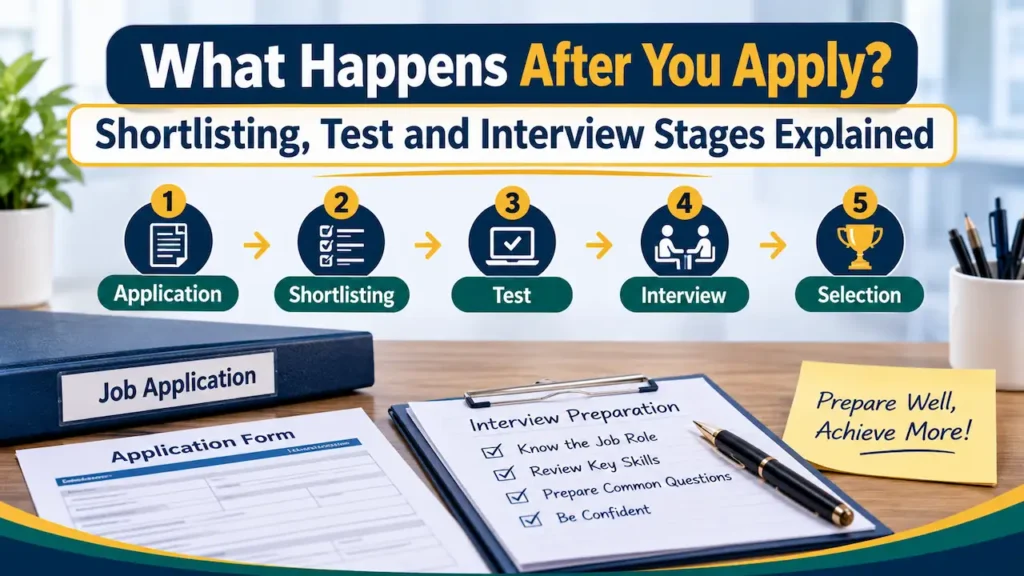
Submitting a government job application is only the beginning of the recruitment process. After the closing date, your application may be checked for eligibility, shortlisted for a test or interview, or assessed through additional stages required for that particular post.
The process is not identical across Pakistan. A recruitment handled by the Punjab Public Service Commission (PPSC) may follow a different sequence from an FPSC recruitment or a department that receives applications through the National Jobs Portal (NJP). Some vacancies require a written test, while others may specify a skill test, interview or another assessment. The advertisement and official instructions for your post determine what happens next.
What usually happens after submitting a government job application?
A recruitment process may include several of these stages:
- Application submission and acknowledgement
- Initial scrutiny of applications
- Eligibility checking and shortlisting
- Written, screening or skill test, if required
- Document verification
- Interview or other assessment
- Final merit, recommendation or selection decision
- Departmental appointment formalities
Not every vacancy includes every stage, and the order can vary. For example, a department may verify documents before an interview, while another may call candidates for a written test before detailed scrutiny.
| Stage | What it means | What you should do |
| Application received | Your online or submitted application has been recorded | Save the confirmation and application details |
| Scrutiny | The recruiting authority checks the information against the advertised conditions | Keep evidence of your qualifications and experience ready |
| Shortlisting | Eligible or qualifying candidates are selected for the next stage | Monitor official notices and messages |
| Test or assessment | Candidates complete the required written, practical or skill assessment | Follow the case-specific instructions |
| Document verification | Original documents and supporting evidence are checked | Prepare the documents requested in the notice |
| Interview | Shortlisted candidates are assessed by an interview board | Review the post and your own qualifications |
| Final result or recommendation | The authority publishes or communicates the outcome | Check the official result and any next instructions |
| Appointment | The hiring department completes the applicable appointment formalities | Follow the department’s offer and joining instructions |
1. Application acknowledgement: Did your application reach the portal?
After submitting an application, first confirm whether the system has recorded it successfully.
Depending on the application method, you may receive:
- An on-screen submission confirmation
- An application or tracking number
- An email or SMS acknowledgement
- A submitted application entry in your online account
- A downloadable application form or receipt
An acknowledgement normally confirms that the application was submitted or recorded. It does not necessarily mean that the recruiting department has accepted your eligibility or shortlisted you.
For applications through NJP, candidates can sign in to their accounts to manage their profiles and applications. NJP’s official FAQ explains that the portal handles the online application facility and technical support, while the recruiting department makes the eligibility and shortlisting decisions.
If you applied through NJP, see our step-by-step guide to applying on the National Jobs Portal.
Practical advice: Save your application number, submission confirmation and any payment receipt required by the specific advertisement. If the portal displays an error or the application status appears incomplete, contact the relevant portal’s official support channel and retain a screenshot of the issue.
2. Initial scrutiny: How applications are checked
After the application deadline, the recruiting authority may scrutinise submitted applications to determine whether candidates meet the advertised conditions.
The checks can include:
- Required educational qualification
- Degree title, subject or discipline
- Division, percentage or CGPA where specified
- Relevant work experience
- Age and applicable relaxation
- Domicile or quota eligibility
- Professional registration or licence, if required
- Required documents and application information
- Compliance with the prescribed application method
The exact checks depend on the advertisement and recruitment rules. A candidate who meets the educational requirement may still be ineligible if another mandatory condition is not satisfied.
For example, a post may require experience after obtaining a particular qualification. Experience gained before that qualification may not meet the advertised condition. Similarly, a degree with a similar name is not automatically accepted as equivalent to the specific qualification required.
NJP makes this division of responsibility clear in its official FAQ: the recruiting department scrutinises applications, determines eligibility and shortlists candidates. NJP provides the online platform and related technical support.
3. Shortlisting: Why some applicants move to the next stage
Shortlisting means that the recruiting authority has selected a group of candidates to proceed to a subsequent stage.
The basis of shortlisting depends on the recruitment method. It may involve checking minimum eligibility, written-test marks, merit position, experience, quota or other criteria specified in the applicable rules.
Being shortlisted does not always mean that every document has been finally accepted. Some authorities conduct further scrutiny when candidates appear for document verification or interview.
A shortlisting notice may contain:
- Candidate names or roll numbers
- Post title and case or advertisement number
- Test or interview instructions
- Date, time and venue
- Documents to bring
- Instructions for downloading a call letter or admission certificate
Read the entire notice. Do not assume that a message saying “shortlisted” is an appointment offer.
Why might an application not be shortlisted?
Possible reasons include:
- The candidate does not meet a mandatory qualification.
- Required experience is missing or does not meet the prescribed conditions.
- The candidate’s age or domicile does not meet the applicable criteria.
- Required information or documents were not provided.
- The application was submitted incorrectly or after the deadline.
- The candidate did not meet the applicable test or merit requirement.
These are examples, not a universal list of rejection grounds. The reason applicable to your application must be determined from the relevant advertisement, rules and official communication.
4. Written test, screening test or skill assessment
If the recruitment requires a test, the authority will issue instructions about the examination.
The test may be:
- An MCQ-based written examination
- A descriptive or subject-based paper
- A professional or technical assessment
- A typing, shorthand or computer proficiency test
- A practical or physical assessment
- A combination of more than one component
The format depends on the post and recruiting authority. A test conducted by a commission is not necessarily the same as an assessment arranged by a department or an outsourced testing organisation.
Before appearing, confirm:
- Your roll number or admission certificate.
- The exact test date, reporting time and examination centre.
- The permitted identity document.
- The paper pattern and syllabus, if published.
- Whether a calculator or other equipment is permitted.
- The rules for negative marking, if applicable.
- Any instructions about answer sheets, attendance or prohibited items.
Do not rely on a test date shared only through an unofficial social media post. Check the commission, department or testing body’s official notice.
5. Document verification: When original documents are checked
Document verification is used to confirm that the information provided in an application is supported by genuine and relevant evidence.
Depending on the recruitment, the authority may ask for documents before a test, after a test, at the interview or at another specified stage.
Common documents requested in government recruitment can include:
- Original CNIC
- Domicile certificate
- Educational degrees and certificates
- Transcripts or detailed marks certificates
- Experience certificates
- Professional registration or licence
- Equivalence or attestation evidence, where required
- Departmental permission or NOC, where applicable
- Recent photographs or other documents specifically listed in the notice
This is a general preparation list, not a claim that every authority requires every document at every stage. Follow the exact document list in your advertisement, call letter or scrutiny notice.
What if your documents are incomplete?
Do not assume that you will automatically receive extra time to provide missing documents. Some authorities specify a deadline or reject applications that do not meet the requirements.
If a document is genuinely unavailable, check whether the relevant authority permits an alternative, provisional certificate or later submission. Obtain clarification from the official recruitment office before relying on an informal assurance.
For further preparation, keep your educational and experience records organised and make sure the information matches what you entered in your application.
6. Interview: What happens after you are called?
An interview is used to assess candidates beyond the information available in their application or written-test performance.
Depending on the position, an interview board may ask about:
- Your educational background
- Subject or professional knowledge
- Previous work experience
- The responsibilities of the advertised post
- Practical situations related to the job
- Communication and problem-solving
- Other competencies relevant to the role
The interview format and marks, where applicable, are determined by the relevant recruitment rules and instructions. Do not assume that every government interview has the same duration, question pattern or passing marks.
Before attending:
- Read the job description and advertisement again.
- Review the subjects related to your qualification.
- Understand the department’s functions and the advertised role.
- Prepare to explain your education and experience accurately.
- Carry the original documents and copies specified in the call letter.
- Reach the venue according to the reporting instructions.
An interview call is not a final selection. Candidates may still be assessed against eligibility requirements, interview performance, merit and the number of available vacancies.
7. How PPSC recruitment stages work
PPSC conducts recruitment for posts referred to it by Punjab government departments and organisations. The process for an individual case depends on its advertisement, service rules and instructions.
A PPSC recruitment case may involve a written examination, a result notice, provisional clearance for interview, document scrutiny and an interview. However, this should not be treated as a mandatory sequence for every PPSC post.
For example, a PPSC-issued written-test result notice for a particular recruitment case stated that candidates were provisionally cleared for interview. It instructed candidates to watch for call-up letters and said they would also be informed through SMS and email. It further required original academic certificates and related documents at interview. The notice clarified that appearing in the result did not itself confer a right to final selection.
This illustrates two important points:
- A written-test result may only establish provisional clearance for the next stage.
- Eligibility and documents may still be examined when the candidate appears for interview.
Candidates should monitor the official PPSC website for case-specific written results, interview schedules, call-up letters, final recommendations and other notices. Do not apply the stages or document instructions of one PPSC case to another without checking the relevant advertisement.
8. How FPSC recruitment stages work
FPSC conducts recruitment tests, examinations and interviews for vacancies referred to it by federal ministries, divisions and departments, as well as competitive examinations under its mandate.
For general recruitment, FPSC provides separate sections on its official website for advertisements, syllabi, admission certificates, shortlisting, merit lists and nominations.
Its official Information Desk explains that candidates may be informed about document scrutiny and interview through public notices, individual schedules and SMS sent to the mobile number supplied in the application.
FPSC also describes a Fast Track System for certain recruitment cases. Under that process, candidates may be called for document scrutiny one day before interview. Candidates found eligible within the prescribed ratio may then appear for interview the following day. This is a specific process, not a promise that every FPSC recruitment will follow the same timetable.
If FPSC declares you ineligible at scrutiny, its Information Desk says a candidate who believes the decision is incorrect may submit a representation within 30 days of rejection by paying the prescribed representation fee. The candidate should read the relevant instructions and provide evidence supporting the claim.
FPSC states that final results are displayed on its website after the required formalities are completed and nominated candidates are also informed individually in writing.
Use the FPSC official website and its Information Desk for the latest instructions. Keep checking the relevant case page rather than relying on a previous recruitment’s schedule.
9. What if you applied through NJP or directly to a department?
Not every government recruitment is conducted by PPSC or FPSC. Some departments manage recruitment themselves and use NJP or another authorised platform to receive applications.
In an NJP-based recruitment:
- NJP provides the online platform for submitting applications.
- The recruiting department checks eligibility.
- The recruiting department decides who is shortlisted.
- The department or its designated testing body communicates the next stage.
- The recruiting department makes the recruitment decision.
A department may require a written test, interview, skill assessment or a combination. Some advertisements may expressly state that recruitment will take place through a walk-in interview without an entry or written test.
Therefore, do not assume that every NJP application will lead to a test, or that NJP itself selects candidates. Read the specific vacancy description and instructions issued by the recruiting department.
10. Final merit, recommendation and appointment
After the required tests, interviews and scrutiny, the recruiting authority completes the selection process according to the applicable rules.
Depending on the recruitment route, the outcome may be published as a result, merit list, recommendation, nomination or selection notice.
These terms should not be treated as interchangeable:
- Test result: Shows a candidate’s performance or qualifying status in a particular test.
- Shortlisting: Identifies candidates who may proceed to another stage.
- Merit list: Shows candidates’ positions under the applicable merit criteria.
- Recommendation or nomination: Indicates that the recruiting commission has recommended or nominated candidates for the relevant vacancies.
- Appointment letter: Is issued by the competent appointing authority under the applicable appointment process.
A recommendation or nomination does not mean that you should ignore later departmental instructions. The hiring department may still complete appointment formalities such as verification, medical assessment or other checks where required by the rules and offer.
Only treat yourself as appointed when you receive the appropriate official appointment communication and meet its conditions.
How to check your recruitment status without missing an update
After submitting an application, use a simple monitoring routine:
- Save the advertisement, application number and submission confirmation.
- Keep your registered mobile number and email address active.
- Check the recruiting authority’s official website for notices and results.
- Sign in to the application portal when it provides a status or tracking facility.
- Check spam and junk folders for official emails.
- Read notices using the correct case number, post title or advertisement number.
- Keep copies of every official message, call letter and submitted document.
- Contact the official helpdesk or recruitment office if a status is unclear.
Do not rely only on a third-party job website, WhatsApp group or social media page for an interview date or selection result. Such sources can alert you to a notice, but the official recruiting authority’s instructions should determine what you do next.
Is there a fixed waiting time after applying?
No single waiting period applies to all government jobs in Pakistan.
The time between application submission, scrutiny, test, interview and final result can vary with the number of applications, nature of the post, recruitment authority, administrative requirements and any legal or procedural issue affecting the case.
Unless the authority has announced a specific schedule, do not assume that a test or interview will take place within a particular number of days or months.
If there is no update, continue checking the official source periodically. Avoid paying anyone who claims they can speed up shortlisting, arrange an interview or guarantee selection.
Official sources for What Happens After Applying for a Government Job
- Punjab Public Service Commission (PPSC): case notices, written results, interview call-up letters and recruitment updates.
- Federal Public Service Commission (FPSC): general recruitment, shortlisting, admission certificates, merit lists, nominations and results.
- FPSC Information Desk: official explanations of scrutiny, interview communication, Fast Track and representations.
- National Jobs Portal (NJP) FAQs: application submission, eligibility, shortlisting responsibility, account support and application status guidance.
- National Jobs Portal: government vacancy listings and candidate accounts.
Pakistan Job Updates is an independent information website. It is not a government department, recruitment commission or official application portal. Always follow the latest advertisement and instructions issued by the authority responsible for your recruitment.