
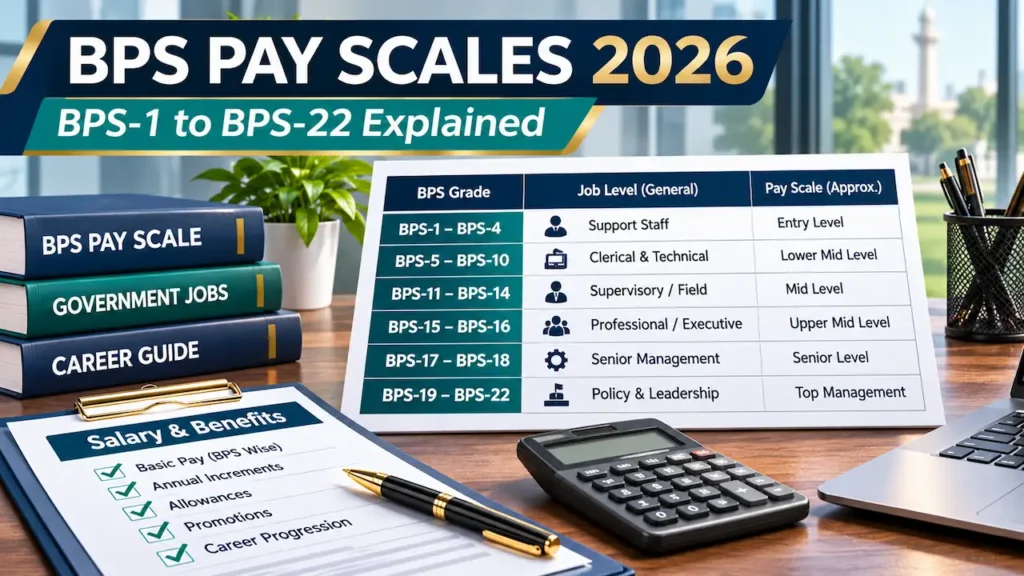
When a government job advertisement mentions BPS-11, BPS-16 or BPS-17, it is identifying the Basic Pay Scale attached to the advertised post. The grade helps applicants understand the post’s basic-pay structure, but it does not tell them the exact salary they will receive every month.
For applicants in Pakistan, it is important to distinguish basic pay, gross salary, allowances and take-home pay. These are different amounts, and the rules can vary between federal and provincial departments and other public-sector organizations.
This guide explains the BPS-1 to BPS-22 structure, the federal pay-scale figures effective from 1 July 2026, annual increments and the factors that affect an employee’s actual salary.
1. What is BPS?
BPS stands for Basic Pay Scale. It is a graded pay structure used for many government posts in Pakistan.
Each BPS grade has a prescribed basic-pay range. The range generally includes:
- Minimum basic pay: The starting amount of the scale.
- Annual increment: The prescribed increase at an eligible increment stage.
- Maximum basic pay: The upper amount of the scale.
For example, a post advertised as BPS-11 is assigned to the BPS-11 pay scale. The employee’s basic pay is fixed within that scale according to the applicable appointment and pay-fixation rules.
A higher BPS number generally represents a higher basic-pay scale. However, the grade alone does not establish the employee’s exact duties, designation, seniority, authority, promotion prospects or total monthly salary.
2. Which BPS pay scale is currently applicable?
Pay-scale figures must be read with their notification date and the government that issued them.
The Finance Division of the Government of Pakistan issued an Office Memorandum on 21 July 2026 introducing the Basic Pay Scales 2026 for the federal civil employees covered by the notification. These scales took effect from 1 July 2026 and replaced the federal Basic Pay Scales 2022.
The notification also explains that the 2022 and 2025 ad-hoc relief allowances were merged into the revised scales, while a separate 2026 ad-hoc relief allowance was sanctioned under the stated conditions.
The table below reproduces the federal BPS-2026 minimum, annual increment and maximum basic-pay figures from that notification. These are basic-pay figures, not gross or take-home salary.
3. Federal Basic Pay Scales 2026: BPS-1 to BPS-22
Effective date: 1 July 2026
| BPS | Minimum basic pay (Rs.) | Annual increment (Rs.) | Maximum basic pay (Rs.) |
| BPS-1 | 16,280 | 520 | 31,880 |
| BPS-2 | 16,600 | 590 | 34,300 |
| BPS-3 | 17,130 | 700 | 38,130 |
| BPS-4 | 17,650 | 800 | 41,650 |
| BPS-5 | 18,300 | 910 | 45,600 |
| BPS-6 | 18,930 | 1,010 | 49,230 |
| BPS-7 | 19,590 | 1,100 | 52,590 |
| BPS-8 | 20,290 | 1,210 | 56,590 |
| BPS-9 | 20,990 | 1,310 | 60,290 |
| BPS-10 | 21,680 | 1,430 | 64,580 |
| BPS-11 | 22,410 | 1,580 | 69,810 |
| BPS-12 | 23,750 | 1,720 | 75,350 |
| BPS-13 | 25,420 | 1,880 | 81,820 |
| BPS-14 | 27,060 | 2,090 | 89,760 |
| BPS-15 | 28,730 | 2,380 | 100,130 |
| BPS-16 | 33,720 | 2,720 | 115,320 |
| BPS-17 | 54,140 | 4,110 | 136,340 |
| BPS-18 | 68,330 | 5,120 | 170,730 |
| BPS-19 | 105,510 | 5,450 | 214,510 |
| BPS-20 | 123,090 | 8,040 | 235,650 |
| BPS-21 | 136,680 | 8,920 | 261,560 |
| BPS-22 | 146,770 | 10,470 | 293,350 |
Source: Finance Division, Government of Pakistan, Office Memorandum No. F.1(2)IMP/2026, dated 21 July 2026.
These figures apply to the federal civil employees covered by that memorandum. They should not automatically be used as the salary table for every provincial department, autonomous body, public-sector corporation or government-funded project.
4. What do BPS-1 to BPS-22 mean?
The BPS number identifies the pay scale assigned to a post. As the grade increases, the minimum, increment and maximum basic-pay amounts also increase under the applicable scale.
However, there is no universal rule that assigns one particular job title or duty to every BPS grade across Pakistan.
A department may advertise an Assistant, Sub-Engineer, Inspector, Lecturer or another designation at a particular grade under its approved service and recruitment rules. Another organization may use a different designation or qualification structure.
The following points help applicants understand the grades:
- BPS-1 to BPS-16: These grades cover a wide range of support, clerical, technical, supervisory and other posts, depending on the department’s service structure.
- BPS-17 to BPS-19: These grades are used for a range of professional, specialist, administrative and management posts. The required qualifications and experience depend on the service or post.
- BPS-20 to BPS-22: These are higher grades used for senior posts in government service structures. The actual responsibilities and appointment arrangements depend on the relevant cadre and rules.
These are broad descriptions, not a fixed designation chart. Do not decide that a post must have a particular qualification or responsibility simply because it is advertised in one of these grades.
5. Minimum, increment and maximum basic pay explained
The three figures in a BPS table have different meanings.
Minimum basic pay
This is the lowest basic-pay stage in the scale.
For example, the federal BPS-11 scale effective from 1 July 2026 has a minimum basic pay of Rs. 22,410.
An employee’s initial pay is fixed under the applicable appointment and pay-fixation rules. The minimum figure is not a promise of the employee’s complete monthly salary.
Annual increment
An annual increment is an increase in basic pay at an eligible stage under the applicable rules.
In the federal BPS-2026 notification, the annual increment continues to be admissible on 1 December each year, subject to existing conditions.
For example, consider an employee whose basic pay is Rs. 22,410 in federal BPS-11:
- Current basic pay: Rs. 22,410
- BPS-11 annual increment: Rs. 1,580
- Basic pay after one admissible increment: Rs. 23,990
This is an illustrative calculation. It assumes the employee is eligible for the full increment and that no separate pay-fixation rule changes the calculation.
An increment is not the same as a promotion. It increases pay within the existing scale; it does not automatically change the employee’s designation or BPS grade.
Maximum basic pay
This is the upper basic-pay stage of the scale.
For federal BPS-11 under the 2026 table, the maximum is Rs. 69,810. Reaching the maximum does not automatically mean an employee will be promoted to BPS-12. Further pay progression depends on the applicable service, time-scale or promotion rules.
6. Basic pay vs gross salary vs take-home salary
These terms are often confused when applicants compare government vacancies.
| Term | Meaning |
| Basic pay | The employee’s pay within the assigned BPS scale |
| Allowances | Additional amounts admissible under applicable rules or a specific package |
| Gross salary | Basic pay plus applicable salary allowances and other payable components before deductions |
| Deductions | Amounts recovered or deducted from salary under applicable rules |
| Take-home salary | The amount remaining after applicable deductions |
Basic pay
Basic pay is the amount fixed within the employee’s pay scale. It is the starting point for several pay-related calculations, but it is not the complete salary.
Allowances
Allowances may include items such as house rent, conveyance, medical, special, executive or ad-hoc relief allowances, depending on the employee’s post, department, location and applicable notifications.
Not every employee receives every allowance. Some allowances have eligibility conditions, fixed rates or special restrictions. Others may be calculated with reference to basic pay.
The federal BPS-2026 notification and its subsequent clarification contain specific rules about allowances. For example, the 2026 notification provides a 7% ad-hoc relief allowance for the covered federal employees under the stated conditions. It also addresses the treatment of existing allowances and the cessation or freezing of specified earlier allowances.
This is why applicants should not calculate a federal employee’s salary simply by adding an assumed percentage to the BPS table.
Gross salary
Gross salary is calculated by adding the salary components that are actually admissible to the employee.
A simplified formula is:
Gross salary = Basic pay + admissible allowances + other payable salary components
The exact components depend on the appointment and applicable government notifications.
Take-home salary
The employee may have deductions such as income tax, provident-fund or pension-related contributions, insurance or welfare contributions, loan recoveries and other authorized deductions.
Not every deduction applies to every employee. The applicable employment terms and payroll rules determine the final amount.
A simplified formula is:
Take-home salary = Gross salary − applicable deductions
Therefore, two employees in the same BPS grade may receive different take-home amounts.
7. Do all provinces use the same BPS salary table?
No. Applicants should distinguish the general BPS structure from the pay-scale notification issued by the government or organization employing them.
The federal government issues pay and allowance notifications for the federal employees covered by its rules. Provincial governments issue their own notifications for their employees.
For example:
- The Finance Division published the federal Basic Pay Scales 2026 notification on 21 July 2026.
- The Sindh Finance Department lists its own 2026 pay-scale revision and related allowance notifications.
- The Finance Department of Khyber Pakhtunkhwa also lists a 2026 revision of basic pay scales and allowances.
- Punjab applicants should consult the current Punjab Finance Department notification and the relevant department’s instructions before using any pay chart.
Even where two governments publish similar or matching minimum and maximum figures, their allowances, eligibility conditions, deductions and implementation rules may differ.
Before relying on a salary figure, check the notification for the exact government, employee category and effective date.
8. Does a higher BPS always mean a better government job?
A higher BPS usually indicates a higher basic-pay scale, but it does not automatically make one vacancy better for every applicant.
Compare the full employment conditions, including:
- Required qualification and professional registration.
- Experience and responsibilities.
- Basic pay and admissible allowances.
- Permanent, contract or project appointment terms.
- Work location and transfer requirements.
- Working hours and nature of duties.
- Promotion and service rules.
- Applicable pension or retirement arrangements.
A lower-BPS post with a clearly defined regular appointment may have different long-term conditions from a higher-paid contractual or project position. Applicants should compare the actual appointment terms rather than choosing a job based only on its BPS number.
9. What is the difference between BPS, time scale and promotion?
These terms describe different aspects of government employment.
BPS: The pay scale assigned to a sanctioned post or position under the applicable structure.
Annual increment: A permitted increase in basic pay within the existing scale, subject to the relevant rules.
Promotion: Appointment to a higher post or grade through the applicable service rules and selection process.
Time-scale benefit: A pay-progression arrangement provided under a specific government policy to eligible employees. It does not necessarily mean that the employee has been promoted to a different post or cadre.
For example, the federal Finance Division has published a separate policy for grant of time scale to civil servants in BPS-1 to BPS-16. This demonstrates that time-scale arrangements are governed by separate policy rather than being an automatic feature of every BPS appointment.
Applicants should not assume that they will receive a time-scale benefit or promotion after a fixed number of years unless the relevant rules or policy provide for it.
10. What if a government job does not mention BPS?
Not every government-related position uses the ordinary BPS structure.
Some vacancies may be advertised under:
- Project Pay Scales (PPS).
- Special Professional Pay Scales (SPPS).
- Management Position Scales (MPS).
- Tenure Track System (TTS) arrangements.
- A fixed or lump-sum salary package.
- Another organization-specific pay structure.
The Finance Division publishes separate instructions for certain special pay scales and contractual positions. Government-funded project positions may also have a separate pay package.
If an advertisement gives a fixed monthly salary instead of a BPS grade, read the package and appointment terms carefully. Do not convert that amount into an assumed BPS grade.
Also check whether the stated amount is a gross package, a basic amount, a consolidated salary or an amount subject to deductions. If the advertisement does not explain this, ask the recruiting organization for clarification.
11. How applicants should use BPS information before applying
When you find a government vacancy, use the BPS information as one part of your decision.
- Identify the employer. Confirm whether the post belongs to a federal department, provincial department, autonomous body or another organization.
- Check the advertised grade. Note the BPS or alternative pay structure stated for the exact post.
- Find the applicable pay notification. Use the latest notification issued by the relevant government or organization.
- Separate basic pay from total salary. Do not treat the minimum BPS amount as the advertised take-home salary.
- Check the allowances. Confirm which allowances apply to the specific employee category and appointment.
- Read the appointment terms. Confirm whether the vacancy is regular, contract-based, project-based or governed by another arrangement.
- Ask about unclear salary details. Use the recruiting authority’s official contact details if the advertisement does not explain the pay package.
For help understanding the other conditions in a vacancy notice, read our guide on how to read a government job advertisement in Pakistan. You can also browse the Government Jobs in Pakistan section for published vacancy information.
Official sources for BPS Pay Scales in Pakistan
Use the relevant government’s own notification when checking pay-scale figures or allowances.
- Finance Division, Government of Pakistan: Revision of Basic Pay Scales and Allowances of Civil Servants 2026
- Finance Division: Clarification Regarding Revision of Basic Pay Scales and Allowances, 4 August 2026
- Finance Division: Pay Fixation and Time Scale
- Finance Division: Appointment of Civil Servants in Special Pay Scales or Contractual Positions, 7 September 2026
- Finance Department, Government of Sindh: Pay Scales
- Finance Department, Government of Khyber Pakhtunkhwa: Revision of Basic Pay Scales and Allowances 2026
For Punjab or another province, consult that province’s current Finance Department notification. Do not use a federal pay table as a substitute for a provincial notification.
Disclaimer: Pakistan Job Updates is an independent information website. It is not a government department, employer or payroll authority. Pay scales, allowances and deductions may change through official notifications. Applicants and employees should confirm the applicable terms with the relevant department before making employment or financial decisions.