
Applying for a government job involves more than completing an online form. Applicants may need to provide identity documents, domicile certificates, educational records, experience letters and other supporting evidence. If these documents are missing, inconsistent or difficult to read, an otherwise eligible application can face problems during scrutiny.
The best approach is to prepare your documents before applying, check that the information matches across records and keep clear digital and physical copies ready.
However, remember that the required documents depend on the specific job advertisement and recruiting authority. Do not assume that every vacancy requires the same certificates, attestation or document uploads.
1. Start by making a document checklist
Before scanning or uploading anything, read the job advertisement and identify the evidence required for the post.
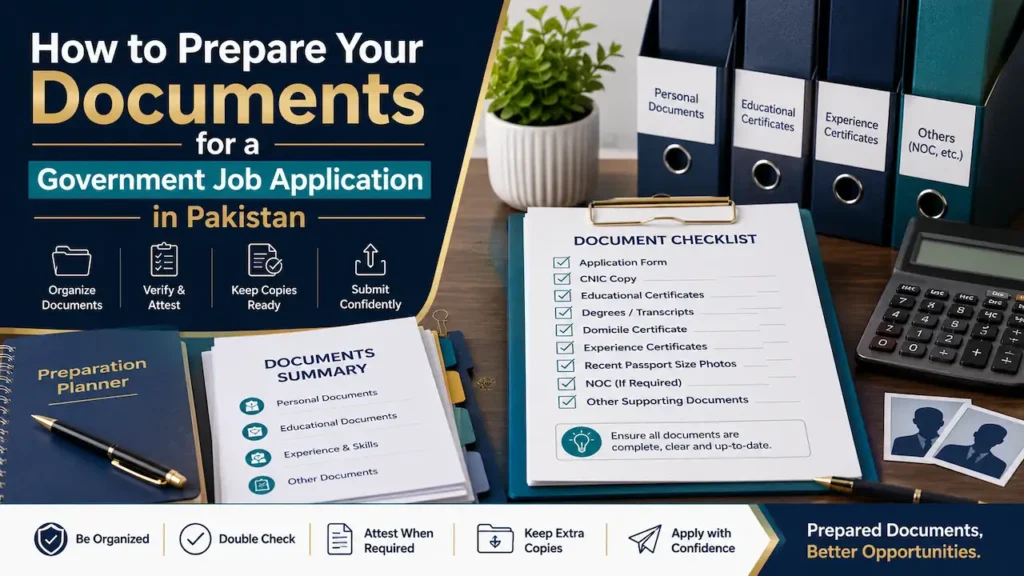
A useful preparation checklist includes:
- Valid CNIC.
- Domicile certificate, where required.
- Matriculation and Intermediate certificates.
- Relevant bachelor’s, master’s or professional degree.
- Transcripts, DMCs or result cards.
- Experience certificates, if the post requires experience.
- Professional registration or licence, where applicable.
- Equivalence certificate, if required for a foreign or different qualification.
- Departmental Permission Certificate (DPC), where applicable to serving government employees.
- Recent photographs, if requested.
- Any additional certificate specifically mentioned in the advertisement or subsequent notice.
This is a preparation list, not a universal official requirement. Some applications initially require only information entered into an online form, while supporting documents may be requested later.
For example, FPSC’s general recruitment instructions distinguish between the documents needed at the screening test and those requested from shortlisted candidates for detailed eligibility scrutiny.
Read FPSC’s General Instructions ->
2. Prepare your CNIC
Your Computerized National Identity Card is an important identity document for government recruitment.
Before applying, check:
- Your CNIC is valid and has not expired.
- Your name is spelled correctly.
- Your father’s or husband’s name, where applicable, is consistent with your other records.
- Your date of birth is correct.
- The CNIC number entered in the application matches the card.
- Both sides of the card are clearly readable in the scanned copy.
Keep a clear image or PDF of the front and back if the application portal requests it.
What if your name or date of birth differs?
Do not ignore differences between your CNIC and educational documents. Even a small spelling variation can create difficulty during document verification or attestation.
Compare your CNIC with your Matric certificate, Intermediate certificate, degree and transcript before applying.
If a genuine correction is needed, contact the relevant issuing authority. Do not edit a scanned certificate or change information yourself to make two documents appear identical.
The Higher Education Commission also instructs applicants to ensure that personal details on their CNIC and educational documents match before applying for degree attestation.
See HEC’s Degree Attestation guidance ->
3. Keep your domicile certificate ready
A domicile certificate can be important when a vacancy is restricted to a particular province, district or regional quota.
Check the following:
- Your name and CNIC details are correct.
- The issuing district and province are clearly mentioned.
- The certificate is readable and complete.
- You are using the domicile relevant to the advertised vacancy.
- The information matches the domicile details entered in the application.
Do not confuse your current residential address with your domicile. Living in a city does not automatically mean that you hold the domicile required for a vacancy there.
Check the advertised quota carefully
A vacancy may be open to applicants across Pakistan, reserved for a particular province or restricted to a specific district. The advertisement determines which domicile is relevant.
For federal recruitment, FPSC’s instructions state that provincial and regional quotas are allocated on the basis of domicile certificates issued by the competent authority. Its instructions also explain that domicile claimed for a selection is treated as final under the stated rules.
Do not assume that the same detailed rules apply to every provincial department or recruiting authority.
4. Organize your educational certificates and degrees
Educational documents are among the most important records in a government job application.
Prepare the certificates and academic records relevant to the advertised qualification.
| Education level | Documents to keep ready |
| Matric | Secondary School Certificate and marks details, where available |
| Intermediate | Higher Secondary School Certificate and marks details, where available |
| Bachelor’s | Degree or provisional certificate and transcript/DMC |
| Master’s | Degree or provisional certificate and transcript/DMC |
| MPhil/PhD | Relevant degree and academic record, if applicable |
| Professional qualification | Relevant certificate, registration or licence, where required |
You do not necessarily need to upload every certificate for every vacancy. If the advertisement requires a bachelor’s degree, for example, follow its exact instructions about whether Matric and Intermediate records must also be submitted.
Degree issued, but certificate not yet received
If you have completed your qualification but have not received the final degree, check what the recruiting authority accepts.
Depending on the advertisement and applicable rules, a provisional certificate or official transcript may be relevant. Do not assume that an unofficial result screenshot or a university portal printout will be accepted as a substitute.
FPSC’s general instructions require the prescribed qualification to have been acquired by the closing date. They also explain that the result declaration date recorded on the transcript is treated as the date of completion for the relevant eligibility assessment.
Check your result declaration date
This is particularly important for posts that require a completed degree by the closing date.
Check the official result declaration date on your transcript or relevant university record. Completing examinations before the deadline does not necessarily establish that the result was officially declared by that date.
If the result date is unclear, obtain clarification or official evidence from your university.
5. Prepare your experience certificates correctly
If a vacancy requires professional experience, an experience letter should provide enough information for the recruiting authority to assess whether your work meets the advertised criteria.
Where applicable, check that the certificate includes:
- Your full name.
- Your designation or job title.
- Employer or organization name.
- Employment start date.
- Employment end date, if you have left.
- Whether you are currently employed, where relevant.
- A description of your duties or responsibilities.
- Signature and designation of the authorized issuing person.
- Official contact details or other verification information, where required.
Keep supporting appointment letters, contracts or salary records if they are available and relevant. These are not automatic substitutes for an experience certificate, but they may help if the recruiting authority asks for additional proof.
Experience must match the advertised requirement
Do not judge your experience only by the number of years written on a certificate.
Check:
- Whether the advertisement requires experience in a specific field.
- Whether experience must be gained after obtaining a particular qualification.
- Whether part-time, internship, honorary or self-employed work is accepted.
- Whether the experience must be full-time or paid.
- The date up to which experience is counted.
For example, FPSC’s general instructions define post-qualification experience according to specified conditions. They describe qualifying experience as relevant work gained after the required qualification, and exclude part-time, honorary, self-employed, apprentice and intern experience under those instructions. These are FPSC rules and should not be presented as universal rules for every employer.
What if your experience letter has no exact dates?
Ask the employer to issue a corrected certificate showing the actual employment period. Avoid relying on vague wording such as “worked for two years” when the recruiting authority requires exact dates.
Never create an experience letter yourself or change the dates on an existing certificate.
6. Check whether attestation or equivalence is required
Applicants sometimes spend time and money getting every document attested even when the job advertisement does not ask for it.
The correct approach is to distinguish between:
- Documents required for the initial application.
- Documents requested during scrutiny or shortlisting.
- Documents required at the interview.
- Documents that must be attested or verified by a particular authority.
Follow the advertisement and the recruiting authority’s later instructions.
HEC attestation for higher education documents
The Higher Education Commission handles attestation of relevant higher education degrees and documents.
HEC introduced a fully online and paperless Degree Attestation System in May 2026. Its current guidance describes online applications through the official e-services portal and the issuance of an e-Attestation Certificate. The process includes uploading readable documents and ensuring that personal and academic details match.
Important: HEC attestation is not automatically required for every government job application. Obtain it when the relevant recruiting authority or another applicable requirement calls for it.
IBCC attestation for Matric and Intermediate documents
The Inter Boards Coordination Commission (IBCC) deals with attestation of relevant secondary and higher-secondary certificates, diplomas and marksheets issued by recognized boards.
IBCC’s guidance states that documents must be verified by the issuing authority before submission for attestation. Requirements can vary according to the document and the service requested.
Read IBCC’s attestation rules ->
Equivalence certificates
If you hold a foreign qualification or a qualification different from the one named in the advertisement, check whether an equivalence certificate from the competent authority is required.
The relevant authority depends on the qualification and profession. HEC and IBCC handle different categories of academic qualifications, while professional councils may be responsible for specific regulated fields.
Do not assume that a degree with a similar title is automatically equivalent to the advertised qualification.
7. Government employees should check the DPC requirement
Candidates already working in government service may need a Departmental Permission Certificate (DPC) or another form of permission under the applicable recruitment rules.
If this applies to you:
- Check the advertisement for the proper-channel requirement.
- Ask your department about the prescribed procedure.
- Use the format required by the recruiting authority, if one is provided.
- Check that the certificate is signed by the authorized officer.
- Keep a copy of the submitted permission.
FPSC’s instructions specifically address Departmental Permission Certificates for serving government employees and state that the required permission must be provided under its applicable instructions.
Do not assume that a DPC is required from every private-sector applicant.
8. Scan and name your documents properly
Once your documents are ready, create clear digital copies.
A good scan should:
- Show the complete document, including all corners.
- Be straight rather than tilted.
- Have readable text and numbers.
- Avoid shadows, glare and blur.
- Include both sides when required.
- Preserve official stamps, signatures and seals.
- Be saved in the file format accepted by the portal.
If a portal accepts PDF files, combine pages carefully and check that the final file opens correctly.
Use simple file names
Organize your files with clear names so you can find the correct document quickly.
Examples:
- CNIC_Front_Back.pdf
- Domicile_Certificate.pdf
- Matric_Certificate.pdf
- Intermediate_Certificate.pdf
- Bachelor_Degree.pdf
- Bachelor_Transcript.pdf
- Experience_Certificate.pdf
- HEC_Equivalence.pdf
These are suggested file names, not official naming requirements.
Check the upload limits
Before uploading, read the portal’s instructions for:
- Accepted file formats.
- Maximum file size.
- Maximum number of files.
- Image dimensions, if specified.
- Whether documents must be uploaded separately or combined.
Do not assume that every recruitment portal accepts the same file size or format. After preparing your digital documents, learn how to apply on the National Jobs Portal (NJP) to understand the online application process and submit your information correctly.
9. Keep original documents safe for tests and interviews
Uploading a scanned copy does not mean you will never need the original document.
Some recruiting authorities ask candidates to produce original documents during a test, scrutiny stage or interview.
For example, FPSC requires candidates appearing in its screening or written tests to bring the original CNIC, original Treasury Receipt and downloaded admission certificate under its stated instructions. It also requires shortlisted candidates to produce original documents at interview.
Prepare a physical folder containing the documents relevant to your particular recruitment:
- Original CNIC.
- Original domicile certificate.
- Original educational certificates and degrees.
- Original transcripts or DMCs.
- Original experience certificates.
- Equivalence or professional registration documents, where applicable.
- Printed application or admission documents, if requested.
- Fee receipt or payment proof, if required.
- Photographs, if requested.
Keep photocopies in a separate section. Follow the exact instructions in your admission certificate, interview letter or document-submission notice.
10. Common document mistakes to avoid
The following mistakes can cause delays or create problems during scrutiny:
1. Different spellings across documents
A name or father’s name may be written differently on the CNIC and academic certificates. Check this before applying and seek correction from the issuing authority when necessary.
2. Uploading an unclear scan
A document may technically upload but still be unreadable. Open every file after scanning and inspect it at normal viewing size.
3. Providing an incomplete degree record
Some applicants upload a degree but overlook the transcript or DMC required to show marks, grades or the result declaration date.
4. Using the wrong domicile
Make sure the domicile matches the province, district or regional requirement in the advertisement.
5. Submitting experience without exact dates
A certificate that does not establish the employment period may be insufficient when the authority requires exact dates and duration.
6. Claiming experience that does not meet the conditions
Check the relevant field, qualification date, employment type and experience cutoff.
7. Waiting until the last day to arrange documents
Obtaining a corrected certificate, DPC, verification or equivalence document may take time. Prepare early.
8. Assuming attestation is always compulsory
Attestation should be completed when the advertisement or recruiting authority requires it—not simply because a document is being used for a government job application.
9. Uploading the wrong file
Before submitting, confirm that the file selected for each upload field is actually the intended document.
10. Failing to preserve originals
Keep original documents safe and do not send them anywhere unless the relevant authority’s official instructions specifically require it.
11. Your final document-readiness checklist
Use this checklist before submitting a government job application.
- CNIC is valid and readable.
- Name, father’s name and date of birth have been checked across documents.
- Required domicile certificate is available.
- Relevant educational certificates and degrees are ready.
- Transcripts, DMCs or result cards are available where required.
- Result declaration date has been checked.
- Experience certificate contains the required details, if experience is needed.
- Professional registration or licence is available, if applicable.
- Equivalence certificate is ready, if required.
- DPC or proper-channel permission is ready, if applicable.
- Attestation or verification has been completed where required.
- Digital scans are clear and saved in accepted formats.
- Portal upload limits have been checked.
- Original documents are safely organized for later stages.
- The advertisement and recruiting authority’s instructions have been checked one final time.
Final advice
Prepare your documents before the application deadline rather than waiting until a recruiting authority asks for them. Keep your identity, domicile, educational and experience records consistent, and make sure every digital copy is readable.
Most importantly, the advertisement and official instructions for the specific recruitment always take priority over a general checklist. Requirements can differ between FPSC, PPSC, provincial departments, autonomous organizations and other employers.
If you are looking for new employment opportunities, explore the latest government jobs in Pakistan to find vacancies announced by federal and provincial departments.
Pakistan Job Updates is an independent information platform. Applicants should confirm document requirements through the relevant department or recruiting authority’s official website before submitting personal records.
Official sources
- Federal Public Service Commission – General Instructions to Candidates
- Higher Education Commission – Degree Attestation
- HEC – Online E-Services Portal
- Inter Boards Coordination Commission – Attestation Rules
- Inter Boards Coordination Commission – Attestation Services
For more useful information about recruitment procedures, application requirements and career opportunities, explore our government job guides.